Somewhere right now, someone is making money off a link they posted while you were asleep. No product, no inventory, no customer service inbox blowing up — just a recommendation and a commission. Sounds too easy to be real, right? It’s not magic, but it is a real business model, and by the end of this guide you’ll know exactly what is affiliate marketing and how it works and how to start.
TL;DR
Affiliate marketing is a performance-based business model where you promote other companies’ products or services using a unique tracking link, and you earn a commission every time someone buys, signs up, or takes a specific action through that link. You don’t create the product, you don’t handle customer service, and you don’t manage inventory or shipping — your job is simply to connect the right audience with the right offer.
In 2026, affiliate marketing remains one of the most accessible ways to start an online income stream because the barrier to entry is low (you don’t need money to create a product), the tools are more beginner-friendly than ever, and AI has made content creation faster than at any point before.
That said, it’s not “passive” in the beginning — it takes consistent content, a real niche, and patience before commissions start rolling in predictably. The people who succeed treat it like a real business: they pick one niche, build trust with an audience, and stack multiple traffic and income sources over time instead of chasing shiny objects.
If you’re brand new, the fastest path forward is: pick a niche you can talk about for months without getting bored, join two or three affiliate programs in that niche, build a simple content hub (blog, YouTube, or social account), and consistently publish content that solves real problems for real people — with your affiliate link included naturally.
What Is Affiliate Marketing, Really?
Let’s strip away the hype for a second. Affiliate marketing is simply referral-based selling, powered by a tracking link instead of a handshake.
Here’s the basic loop:
- A company creates a product or service (software, a course, a physical product, a subscription).
- That company sets up an affiliate program so other people can promote it in exchange for a commission.
- You sign up for that affiliate program and get a unique link.
- You share that link with your audience — through a blog post, video, social media, or email.
- When someone clicks your link and buys (or signs up, depending on the offer), the sale gets tracked back to you.
- You get paid a percentage of the sale, a flat fee, or a recurring commission, depending on the program.
That’s it. That’s the entire mechanism. Everything else — the content strategy, the SEO, the email list building, the AI tools — exists to make step 4 and step 5 happen more often and more predictably.
Why Affiliate Marketing Works as a Business Model
Affiliate marketing sits at an interesting intersection: it benefits the company (they only pay when a sale actually happens, so it’s low-risk marketing spend for them), and it benefits you (you get to monetize an audience or content without ever building, storing, or shipping a product).
Compare that to a traditional product business:
This is exactly why affiliate marketing is often recommended as a starting point for people testing their first online income stream — the downside risk is mostly your time, not your savings.
A Realistic Look: How Do Affiliates Actually Get Paid?
Not all affiliate programs pay the same way, and understanding these models will change how you choose what to promote.
Pay-Per-Sale (PPS) The most common model. You earn a percentage (or flat amount) whenever someone buys through your link. Common in software, courses, and physical products.
Pay-Per-Lead (PPL) You get paid when someone takes an action — signing up for a free trial, filling out a form, booking a call — even if they don’t buy immediately. Common in finance, software trials, and service businesses.
Recurring Commissions Instead of a one-time payout, you earn a commission every month the referred customer stays subscribed. This is one of the most powerful models for building toward real passive income, since your past referrals keep paying you as long as they stay subscribed.
Pay-Per-Click (PPC) Rare today, but some programs pay a small amount per click regardless of conversion. Usually not worth building a strategy around, since it undervalues actual buyer intent.
Common Affiliate Marketing Niches (And What Actually Works)
Not every niche is created equal for a beginner. Here’s an honest breakdown:
Software & SaaS Tools Things like funnel builders, email marketing platforms, and hosting companies. These often have recurring commissions and appeal to an audience that’s already spending money to solve business problems — meaning they’re more likely to buy again.
Online Education & Courses Higher commission percentages, but requires more trust-building content since the buyer is making a bigger decision.
Physical Products (Amazon Associates, etc.) Lower commission percentages, but massive product selection and very high buyer intent if you’re doing review or comparison content.
Finance & Fintech Can pay very well per lead, but comes with more regulatory sensitivity and stricter content requirements.
Health & Wellness Huge audience demand, but heavily saturated and sometimes restricted by ad platforms.
The Content Side: How You Actually Get Clicks
This is the part beginners underestimate. Having an affiliate link means nothing without traffic and trust. Here are the core content formats that consistently work:
Comparison Posts (“X vs Y”) — These target people who are already deciding between two tools, meaning they’re close to a purchase decision. High buyer intent, relatively easy to rank for in search engines.
Review Posts — In-depth, honest breakdowns of a single product. Works best when you include real pros and cons instead of pure hype, since audiences (and search engines) increasingly reward authenticity.
“Best Of” Roundups — Lists like “Best Email Marketing Tools for Beginners.” These capture broader search traffic from people still exploring options.
Tutorial/How-To Content — Teaching someone how to do something using the tool you’re promoting. This builds trust because you’re providing value first, and the affiliate link becomes a natural next step rather than a hard sell.
Case Studies / Personal Results — Sharing your own results (or a client’s) using a product. Extremely persuasive when done honestly, since it shows proof instead of just claims.
What Beginners Get Wrong About Affiliate Marketing
Mistake 1: Promoting too many things at once. New affiliates often join ten programs in month one and spread thin content across all of them. Focus converts better than breadth, especially early on.
Mistake 2: Skipping the “why should I trust you” step. A link with no context, no story, and no real opinion rarely converts. Audiences buy from people they trust, not just people with a link.
Mistake 3: Expecting overnight income. Affiliate marketing compounds. Content published today can keep earning for months or years, but the first 60–90 days are usually the slowest, most discouraging stretch — and also the stretch where most people quit right before it would’ve paid off.
Mistake 4: Ignoring SEO or an audience-building channel entirely. Posting a link with no distribution plan is the single most common reason beginners see zero results. You need a channel — a blog, a YouTube channel, an email list, or a social following — where people are actually finding your content.
Mistake 5: Not disclosing affiliate relationships. Beyond being a legal requirement in most countries (including FTC guidelines in the US), transparency about affiliate links actually builds more trust, not less.
How Much Can You Realistically Make?
This deserves an honest answer instead of a hype-driven one. Affiliate income exists on a wide spectrum:
The pattern across almost every success story is the same: consistency over a long enough runway, paired with genuinely useful content, rather than any single hack or trick.
Getting Started: A Simple Beginner Framework
- Pick one niche you can realistically create content about for the next 6–12 months without losing interest.
- Join 2–3 affiliate programs in that niche — prioritize ones with recurring commissions if available.
- Choose one primary content channel (blog, YouTube, or a specific social platform) instead of trying to be everywhere at once.
- Publish consistently. Weekly is a reasonable starting cadence; daily is even better if it’s sustainable.
- Lead with value, not the link. Solve a real problem, answer a real question, then mention the product as the natural solution.
- Track what converts and double down on the content formats and topics that actually generate clicks and sales.
- Build an email list early, even a small one — it’s the one channel you fully own, unlike social media algorithms that can change overnight.
Is Affiliate Marketing Still Worth Starting in 2026?
Yes — with a realistic mindset. The tools have gotten better (AI-assisted content creation, easier funnel builders, more accessible design tools), which means the technical barrier to entry has never been lower. But that also means more competition, so the affiliates who win are the ones who focus on genuine trust-building and useful content rather than volume alone.
If you’re patient enough to treat this as a real business — not a get-rich-quick scheme — affiliate marketing remains one of the most realistic on-ramps to online income, especially if you don’t have capital to invest in building your own product yet.
Frequently Asked Questions
Also Read:
- How to Make Money Online With AI in 2026 — The Complete Beginner’s Guide
- How You Can Use AI to Earn Your First $ 1,000 Online in 7 Ways
- Can AI Help You Build Passive Income in 2026?
- AI Online Income vs Traditional Online Income — What’s Actually Different in 2026?
- 5 Mistakes Beginners Make Trying to Earn Online
- Best Free AI Tools to Make Money Online in 2026
- Best Free AI Tools for Writing Content in 2026
- Best Free AI Tools for Social Media Marketing in 2026
- The Most Affordable Way Ever to Buy a Domain and Set Up WordPress
There are two kinds of people trying to build income online: Action Takers and I-Willers. The I-Willer says, “I’ll start tomorrow,” “I’ll join when I have more time,” “I’ll figure it out on my own first.”
Meanwhile, the Action Taker is already three modules deep, already making mistakes, already learning faster than the I-Willer ever will — because doing beats intending, every single time. The truth is, “I will” is just a polite way of saying “not yet,” and not yet has a way of turning into never.
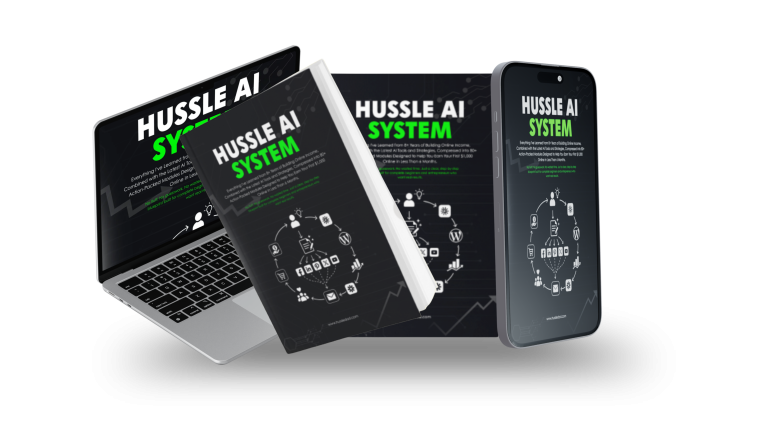
The Hussle AI System isn’t for people waiting for the perfect moment — it’s for people who are done waiting. If you’re tired of being an I-Willer, this is your on-ramp to becoming an Action Taker. Join now, learn it right, and start building — today, not “someday.