If you are relying solely on social media algorithms or directly pasting affiliate links into your bio to make a living online, you are building your business on rented land.
Every time a platform changes its algorithm or updates its terms of service, your income is at risk.
To build a sustainable online business—whether you are selling digital products, SaaS tools, or your own expertise—you need a system that captures attention, builds trust, and predictably converts strangers into paying customers without your constant manual intervention.
However, most beginners approach funnels backward. They focus on the software—obsessing over which platform has the best page builder—before they understand the psychology behind the customer journey.
In this guide, we are tearing down the complexities of sales funnel architecture. We will explore the first principles of why funnels work, the essential stages of a high-converting system, and a practical, step-by-step roadmap to mapping out your first automated revenue engine.
What is Sales Funnel Architecture? (First-Principles Thinking)
At its core, a sales funnel is the intentional, step-by-step process a prospect goes through, from the moment they first discover your brand to the moment they make a purchase (and beyond).
When you strip away the landing pages, the email autoresponders, and the checkout carts, the architecture of a sales funnel is simply applied psychology. It is the framework for delivering the right message to the right person at the right time.
The Difference Between a Website and a Sales Funnel
Most traditional websites are digital brochures. They have a homepage, an “About” page, a blog, a contact form, and links to various products. A visitor lands on the site and is presented with dozens of choices.
This creates decision fatigue. When presented with too many options, the default human response is to take no action at all and leave.
A sales funnel eliminates choice. It is linear.
Sales funnel architecture is designed to reduce friction and guide the user toward one specific, highly optimized conversion goal.
The “Value Ladder” Concept Explained
You cannot understand funnel architecture without understanding the Value Ladder.
If you walk up to a stranger on the street and ask them for $1,000, they will reject you. There is no trust, and the perceived risk is too high. But if you offer them a free, highly valuable piece of advice, they will listen. If that advice solves a problem, they will trust you enough to buy a $20 product. If that $20 product delivers exceptional value, they are now primed for the $1,000 offer.
The Value Ladder maps out your product ecosystem:
- Free (The Bait): Content, YouTube videos, blog posts.
- Low Ticket (The Tripwire): A $7 to $27 impulse buy (e.g., an eBook or template) designed to convert a lead into a buyer.
- Core Offer: Your primary product, course, or affiliate recommendation ($100 – $500).
- High Ticket (The Backend): Coaching, consulting, or premium software bundles ($1,000+).
Your sales funnel is the automated system that walks people up this ladder.
The 4 Core Stages of a High-Converting Funnel (AIDA Framework)
The most robust funnel architecture is built on the classic AIDA model: Awareness, Interest, Desire, and Action. Let’s break down how this looks in a modern digital business.
Stage 1: Awareness (Top of Funnel – ToFu)

This is where the prospect realizes they have a problem, and they discover that you might have the solution. Your only goal at this stage is to capture attention.
Stage 2: Interest (Middle of Funnel – MoFu)

The prospect is now aware of you and is actively seeking more information. You have their attention; now you need to capture their contact information. You do this by offering an irresistible “Lead Magnet.”
Stage 3: Desire (Bottom of Funnel – BoFu)
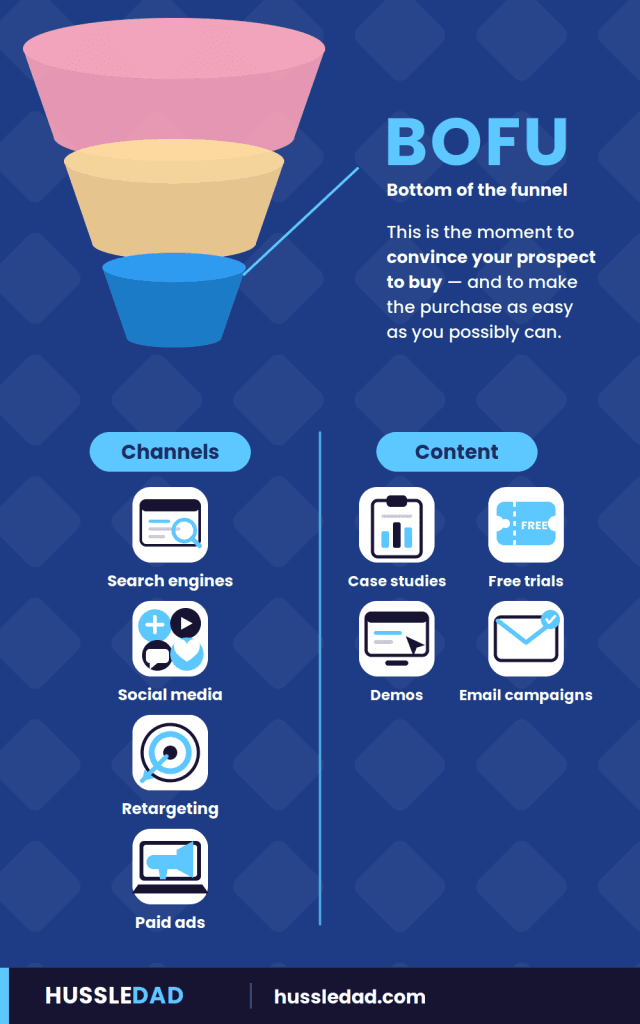
The prospect is now on your email list. They are evaluating their options. This is the crucial nurturing phase where you build EEAT (Experience, Expertise, Authoritativeness, and Trustworthiness). Email marketing is the undisputed king here; industry data consistently shows that email delivers an average return of $36 to $42 for every $1 invested.
Stage 4: Action (The Conversion Point)
The prospect is ready to buy. Your architecture must now facilitate a seamless, frictionless transaction.
Mapping Out Your First Automated Funnel (Step-by-Step)
Now that you understand the theory, let’s build a practical, automated architecture suitable for digital products, affiliate marketing, or coaching.
Step 1: Designing the Irresistible Lead Magnet
Your funnel will fail if your lead magnet is weak. Stop offering a “Free Weekly Newsletter” (nobody wants more email).
Offer a specific solution to a specific problem.
Step 2: The Opt-In / Squeeze Page Anatomy
The architecture of a high-converting opt-in page must be brutally simple. Remove the navigation bar. Remove the footer links. Give the user one choice.
Key Elements:
- The Headline: The most important element. It must clearly state the big promise (e.g., “Steal My Exact Prompt Framework for Writing 2,500-Word Articles”).
- The Sub-headline: Explains how they will achieve the promise.
- The Visual: A high-quality mockup of the lead magnet (e.g., an image of a PDF or a video thumbnail).
- The Form: Keep it simple. Ask only for their First Name and Email Address. Every additional field reduces your conversion rate.
- The Call to Action (CTA): Instead of a generic “Submit,” use action-oriented text like “Send Me the Free Checklist.”
Step 3: The Bridge Page / Thank You Page Strategy
This is the most underutilized piece of real estate in funnel architecture.
Immediately after a user opts in, do not just show a generic “Thank you, check your email” page. They are in a state of high intent. Use this Bridge Page to introduce your Core Offer or a Tripwire.
The Bridge Page Script:
- Acknowledge: “Success! Your free checklist is on its way to your inbox right now.”
- Transition: “While you wait, I want to show you the exact system I used to…”
- The Pitch: Introduce your low-ticket offer or an affiliate product that perfectly complements the free lead magnet they just requested.
Step 4: The 5-Day Email Nurture Sequence
Once they are on your list, automation takes over. A standard, highly effective nurture architecture looks like this:
- Day 1 (Immediate): The Delivery & Welcome. Deliver the lead magnet. Introduce yourself, tell your core story, and set expectations for future emails.
- Day 2: The Epiphany Bridge. Share a story of a struggle you (or a client) faced that relates to their problem, and the “aha!” moment when you discovered the solution (your product/affiliate offer).
- Day 3: The Hidden Benefit. Discuss a secondary, unexpected benefit of your solution that competitors rarely talk about.
- Day 4: Logic and Proof. Provide the data. Share case studies, testimonials, and statistics that prove your system works.
- Day 5: Urgency and Call to Action. Make a strong push for the sale. Introduce a deadline, a disappearing bonus, or a compelling reason to act today.
Why Most Beginner Funnels Fail (And How to Fix Them)
If you have launched a funnel and it isn’t converting, the problem is rarely the software. It usually comes down to one of these three architectural flaws.
1. Friction in the Opt-in Process
Are you asking for a phone number on a top-of-funnel squeeze page? Are there broken links?Does the page take more than 3 seconds to load on mobile? A Google/Deloitte study found that even a 0.1-second improvement in mobile site speed increased retail conversion rates by 8.4%. Users have zero patience for a slow page. Reduce the steps required to say ‘yes.
2. Misaligned Search Intent vs. Offer
There must be a logical, seamless flow from the ad/content to the lead magnet, to the core offer.
3. Ignoring the Post-Purchase Experience
Many marketers stop caring once the credit card is charged. This destroys lifetime customer value (LTV). Your funnel architecture must include a brilliant onboarding process, immediate delivery of the product, and follow-up emails asking for feedback to reduce buyer’s remorse and refund rates.
Frequently Asked Questions
Key Takeaways & Next Steps
Building a sales funnel is not about manipulating people; it is about providing a structured, frictionless path for them to solve their problems.
Also Read:
- How to Choose Your First Affiliate Niche (Without Overthinking It in 2026)
- How to Make Money Online With AI in 2026 — The Complete Beginner’s Guide
- How You Can Use AI to Earn Your First $ 1,000 Online in 7 Ways
- Can AI Help You Build Passive Income in 2026?
- AI Online Income vs Traditional Online Income — What’s Actually Different in 2026?
- 5 Mistakes Beginners Make Trying to Earn Online
- Best Free AI Tools to Make Money Online in 2026
- Best Free AI Tools for Writing Content in 2026
- Best Free AI Tools for Social Media Marketing in 2026
- The Most Affordable Way Ever to Buy a Domain and Set Up WordPress
- What is Affiliate Marketing? A Beginner’s Guide for 2026
- ClickFunnels Review 2026: Is It Still Worth It? (Plus My Bonuses)